
Skip to content Call Us: (405) 722-7767

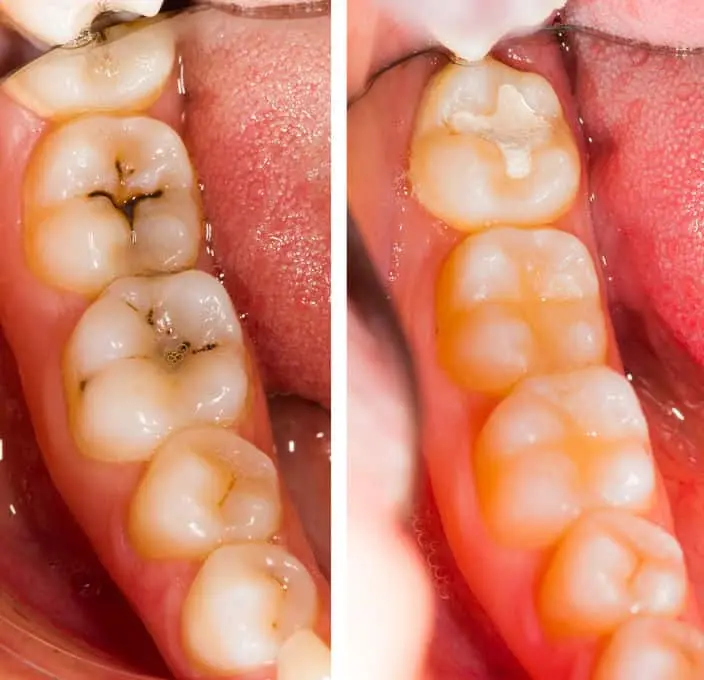
A filling repairs a tooth with a cavity or a small chip or crack. At Dentistry For You OKC, Dr. Dao places tooth-colored composite fillings. They bond to the tooth rather than relying on shape alone to stay put, so less healthy tooth has to be removed to hold them in place.

How Cavities Start

Bacteria in plaque feed on sugar and produce acid. That acid draws minerals out of your enamel. Between meals, saliva rinses the acid away and puts some of those minerals back.

A cavity forms when that balance tips the wrong way too often. That's why how often you have sugar matters more than how much: a dessert finished in ten minutes is one acid attack, but a sweet drink sipped all afternoon keeps the attack going for hours.

At the very earliest stage, before there's a hole, the damage can often be reversed with fluoride and better cleaning. Once the surface breaks down, it can't heal on its own and needs a filling.

A composite filling being shaped
A dentist working on a reclined patient with a handpiece

Why Early Cavity Care Matters

A cavity doesn’t stay the same size. Enamel is hard, so decay moves through it slowly, but once it reaches the softer layer below (the dentin) it spreads much faster.

The pattern is predictable. A small cavity means a small filling. A larger one means a bigger filling that weakens the tooth. Larger still, and the tooth needs a crown. If decay reaches the nerve, it becomes a root canal, and if infection goes further, the tooth may need to come out and be replaced.

Found at the right time, the same tooth needs the simplest and least costly repair. That’s the whole point of regular six-month checkups.

What Happens at Your Filling Visit

First, we numb the tooth. Dr. Dao removes the decay, which is softer than healthy tooth, and shapes what’s left. The area is kept dry, since composite doesn’t bond well to a wet surface.

The composite goes on as a soft paste and is built up in thin layers, with each layer hardened by a curing light. The shade is matched to your tooth. Once it’s built up, it’s shaped to follow the tooth’s natural contours, and we check your bite by having you tap and slide your teeth together, adjusting until it feels normal.

Most single fillings take under an hour, and composite is hard as soon as it’s cured, so there’s no waiting to eat. The numbness lasts a couple of hours, so be careful not to bite your cheek or tongue until it wears off.

Tooth-Colored vs. Silver Fillings

Composite is what we use. It matches your tooth, bonds to it so less tooth needs to be removed, and doesn’t require extra grooves cut into the tooth to hold it.

Amalgam, the silver material many people got as kids, is durable and was the standard for decades. If your silver fillings are still in good shape, there’s usually no reason to replace them, since doing so removes more tooth without a health benefit. When one cracks, leaks or has decay under it, that’s a good time to switch to a tooth-colored material. Learn more on our metal-free dentistry page.

When a Filling Isn't Enough

A filling can only replace so much of a tooth. When a filling gets very large, it can act like a wedge, and the remaining walls of the tooth become more likely to split.

At that stage a crown is usually the better choice, because it holds the tooth together instead of pushing it apart. Dr. Dao will let you know when a tooth has reached that point rather than placing a filling that's likely to fail.

Making Fillings Last

Most fillings fail at the edge, where the filling meets the tooth, because that seam is where new decay starts. Clean between your teeth every day, since the spots where teeth touch are exactly where a toothbrush can't reach.

If you grind your teeth, a night guard protects your fillings along with your natural enamel. Call (405) 722-7767 or use our contact form.

Get It Checked Before It Grows

A cavity found early means a small filling. Left alone, it can turn into a crown or a root canal.